
Choosing the right hosting plan can be confusing, especially when deciding between Shared Hosting and Reseller Hosting. Both are designed to host websites, but they serve very different purposes.
What is Shared Hosting?
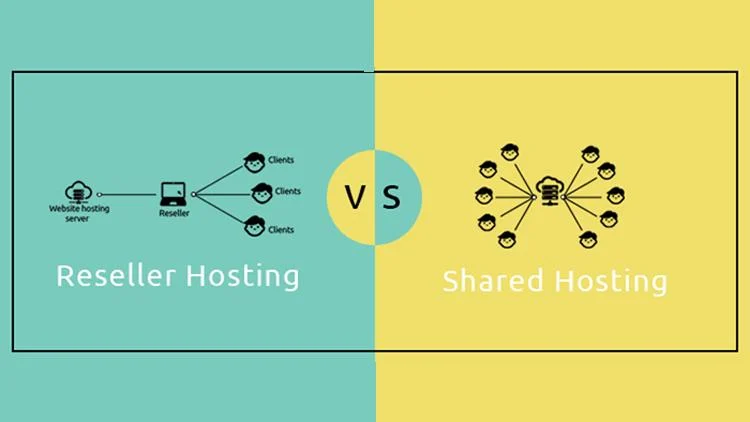
Shared Hosting is a hosting service where multiple websites share the resources of a single physical server.
The hosting provider manages the server infrastructure, security, software, and other technical components. You simply purchase a hosting plan and use the provided control panel to manage your website.
How Shared Hosting Works
For example, imagine one server has several resources:
- CPU
- RAM
- SSD/NVMe storage
- Bandwidth
- Database resources
These resources are shared among multiple hosting customers.
A typical setup looks like:
Server → Shared Hosting → Your Account → Your Website
Shared Hosting is generally suitable for:
- Personal websites
- Blogs
- Small business websites
- Portfolio websites
- Small WordPress websites
- Landing pages
- New websites
What is Reseller Hosting?
Reseller Hosting is a hosting service that allows you to purchase hosting resources and then create multiple separate hosting accounts for your own customers.
Instead of using the hosting only for your own website, you can operate a small hosting business or provide hosting to clients.
A typical setup looks like:
Server → Reseller Account → Multiple cPanel Accounts → Multiple Customer Websites
Reseller Hosting usually includes WHM (Web Host Manager), which allows you to create and manage individual cPanel hosting accounts.
For example, if you are a web designer and have 20 clients, you can create a separate hosting account for each client.
Shared Hosting vs Reseller Hosting
| Feature | Shared Hosting | Reseller Hosting |
|---|---|---|
| Main Purpose | Host your own website | Host multiple clients/websites |
| Account Type | Individual hosting account | Hosting reseller account |
| WHM | Usually No | Usually Yes |
| cPanel | Usually Yes | Usually Yes for created accounts |
| Multiple Customers | No | Yes |
| Create Separate Hosting Accounts | Usually No | Yes |
| Branding | Limited | Often supports private/white-label branding |
| Resource Management | Provider controlled | Reseller allocates resources |
| Hosting Business | Not suitable | Suitable |
| Technical Knowledge | Beginner-friendly | Requires more knowledge |
| Price | Usually lower | Usually higher |
| Best For | Website owners | Web designers/agencies/hosting businesses |
1. Purpose
The biggest difference is the purpose.
Shared Hosting
Shared Hosting is primarily designed for someone who wants to host a website.
For example:
You have a business website called
example.comand need hosting for it.
A Shared Hosting plan may be enough.
Reseller Hosting
Reseller Hosting is designed for people who want to host multiple websites or customers.
For example:
You build websites for 20 customers and want to provide hosting to each customer.
Reseller Hosting would be more appropriate.
2. cPanel and WHM
Shared Hosting normally provides you with cPanel.
You use cPanel to manage:
- Website files
- Domains
- Email accounts
- Databases
- SSL
- Backups
- FTP
- WordPress
Reseller Hosting generally provides WHM + cPanel.
WHM is used by the reseller to create and manage individual hosting accounts.
For example:
WHM
↓
Customer 1 → cPanel → Website A
Customer 2 → cPanel → Website B
Customer 3 → cPanel → Website C
This makes Reseller Hosting much more useful for agencies and hosting businesses.
3. Number of Websites
With Shared Hosting, the number of websites you can host depends on your package.
Some plans may allow:
- 1 website
- 5 websites
- 10 websites
- Unlimited websites
However, all websites are generally managed under your own hosting account.
With Reseller Hosting, you can create separate hosting accounts for different customers, subject to the provider’s limits.
This provides much better account separation.
4. Customer Management
Shared Hosting isn’t designed for managing customers.
For example, if you have 10 clients, putting all 10 websites into one Shared Hosting account can become difficult to manage.
With Reseller Hosting, you can create separate accounts:
Client A → Account 1
Client B → Account 2
Client C → Account 3
Each customer can have their own cPanel login.
5. Branding
Reseller Hosting is often useful for businesses that want to sell hosting under their own brand.
For example, a company could sell:
BD IT HOST Web Hosting
instead of advertising the underlying hosting provider.
Depending on the reseller provider, you may be able to customize:
- Hosting packages
- Account names
- Branding
- Nameservers
- Customer access
- Resource limits
The exact white-label features depend on the reseller provider.
6. Resource Allocation
With Shared Hosting, the hosting provider controls the overall server environment and determines the resources available to your account.
With Reseller Hosting, you can usually allocate specific resources to individual hosting accounts.
For example:
Basic Package
- 5 GB Storage
- 50 GB Bandwidth
- 1 Website
Business Package
- 15 GB Storage
- 150 GB Bandwidth
- 3 Websites
You can create your own packages depending on the features provided by your reseller service.
7. Price
Shared Hosting is generally cheaper because it is designed for individual website owners.
Reseller Hosting costs more because it provides additional management capabilities and allows you to create multiple hosting accounts.
However, Reseller Hosting can potentially be more profitable if you sell hosting to customers.
8. Technical Knowledge
Shared Hosting
Shared Hosting is suitable for beginners.
You usually don’t need advanced server-management knowledge.
You can manage your website through cPanel.
Reseller Hosting
Reseller Hosting requires a little more knowledge.
You should understand:
- WHM
- cPanel
- DNS
- Nameservers
- SSL
- Email configuration
- Resource allocation
- Backups
- Basic server security
- Customer account management
You don’t necessarily need to be a server administrator, because the underlying server is usually managed by the hosting provider.
9. Security and Isolation
Shared Hosting places multiple websites on the same server environment.
Modern hosting providers use various security and isolation technologies, but the exact level of isolation depends on the provider and server configuration.
Reseller Hosting provides separate customer accounts, which can make management and account separation easier.
However, Reseller Hosting is not the same as having a dedicated server. The underlying server resources are still shared with other users/resellers depending on the provider.
10. Who Should Choose Shared Hosting?
Choose Shared Hosting if you:
- Have one or a few websites
- Are starting a new website
- Run a personal blog
- Own a small business website
- Want affordable hosting
- Don’t need customer hosting accounts
- Don’t want to manage hosting customers
Example
A small restaurant has a website with:
- Home
- About
- Menu
- Contact
- Gallery
They probably don’t need Reseller Hosting.
Shared Hosting would likely be sufficient.
11. Who Should Choose Reseller Hosting?
Choose Reseller Hosting if you:
- Build websites for clients
- Run a web design agency
- Want to start a hosting business
- Manage multiple customer websites
- Want separate cPanel accounts
- Want to create your own hosting packages
- Want to sell hosting under your own brand
Example
Suppose you are a web developer and have:
- 10 website clients
- 15 WordPress websites
- 5 business websites
You can create separate hosting accounts for your clients using Reseller Hosting.
Shared Hosting vs Reseller Hosting: Which is Better?
There is no universal winner.
It depends on your requirements.
Choose Shared Hosting if:
You need hosting for your own website.
Choose Reseller Hosting if:
You want to host and manage websites for multiple customers or sell hosting services.
The simplest way to remember it is:
Shared Hosting = Host your website.
Reseller Hosting = Host websites for your customers.
Final Comparison
If you are a beginner with a single website, Shared Hosting is usually the better starting point because it is simple and affordable.
If you are a web designer, developer, agency, freelancer, or hosting business and want to provide hosting to multiple customers, Reseller Hosting is generally the more suitable option.
And if your business grows significantly, you may eventually consider moving from Reseller Hosting to a VPS or Dedicated Server, depending on your resource requirements and technical needs.